Showing posts sorted by relevance for query painting. Sort by date Show all posts

Monday, 15 July 2013

Grade 10: Acrylic painting

 Create a surreal composition, using an egg.
  
 Thumbnail Sketches & Experiments


link to clip on transposing thumbnails into final sketches


Paint in the cool dark colours first, then add warm colours and lastly some blending with oils.


Monochrome under-painting


We will start our surreal egg paintings by creating  illusions of form and space using one dark colour and white. (A monochrome) This is a very old traditional technique used by Vermeer.


However, we will use acrylics for our monochrome because it dries faster. Mix your own dark - try and avoid using black. Remember to work into both figure and ground.

We will work over the monochrome (the 'grisaille') with  local (representational) colours.

 Lastly, we will use oil paints to blend and adjust the colours and tones.


Link to a tutorial
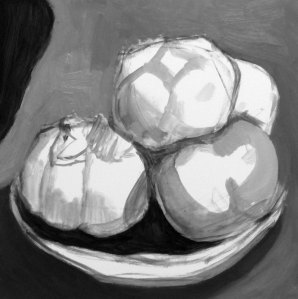
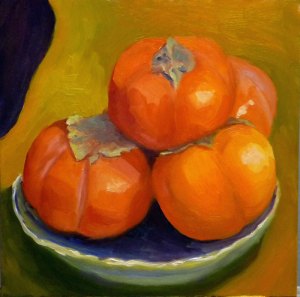
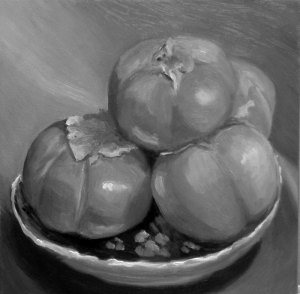
#2- Continuing monochrome acrylic underpainting #4 - oil painting cont. B&W photo to check values of finished painting
this artist takes a black and white photo to check her values at the end of her painting, read more by clicking on her blog below.
http://janabouc.wordpress.com/2008/12/08/pile-o-persimmons/


http://artid.com/members/eleanormcintosh/blog/post/4392-oil-painting-using-an-underpainting
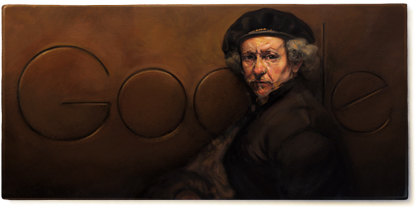
Rembrandt van Rijn's 407th birthday
it's Rembrandt's 407th birthday today.

Some Painting revision clips:

colour mixing

painting posts

packing tape transfers

Tuesday, 21 May 2013

Grade 10 Watercolor egg project


Two exquisite egg paintings by Shirley Royal, a family friend of mine.


Posts From Mrs Moore's blog:

Egg photo

Beautiful egg 'landscape'  by Grade 10 learners. (Tayla & Taylin?) Look at some of Dali's landscapes to appreciate how 'surreal' this photo already is.


Egg project

For my Grade 10s .....

Try this composition of mine in watercolours. 
Look at your collage and watercolour 'cloud' for paint guidance.


Now try your own photoshoot.....

Use the photographic references you have taken.
Start the painting by drawing in soft, light pencil. Remove the excess graphite.
Do the under-painting with watercolour washes – work over the wholepage with the lightest value colours. Pat out some whites.
Let dry.

When dry, add darker transparent washes over some of the under-painting to add illusions of form. Hard edge = no wet paper; blurry blended edges = on dampened  paper.
Repeat as necessary………

Scan to document the painting as it grows.

Lastly,  work over the painting with pen & ink.

Thursday, 8 May 2014

Summary of Romantic Characteristics

The following Summary is based on  quotes from Shelley Esaak's Article: Romanticism - Art History 101 Basics: 1800-1880


Read the full article by clicking on the web address below:

"Romanticism is precisely situated neither in choice of subject nor in exact truth, but in a way of feeling." -- Charles Baudelaire (1821-1867)

"When we talk about Romanticism the Movement, we aren't using the root word "romance" in the sense of hearts and flowers or infatuation. Instead, we use "romance" in the sense of glorification.
Therefore Romanticisim is the glorification of concepts and things that Romantics were fighting against. Romantic visual and literary artists glorified things ... which takes us to thorny problem number two: the "things" they glorified were hardly ever physical. 

They glorified huge, complex concepts such as liberty, survival, ideals, hope, awe, heroism, despair, and the various sensations that nature evokes in humans. All of these are felt -- and felt on an individual, highly subjective level.   
Aside from promoting intangible ideas, Romanticism may also be loosely defined by what it stood against. The movement championed spiritualism over science, instinct over deliberation, nature over industry, democracy over subjugation, and the rusticity over the aristocracy. Again, these are all concepts open to extremely personalized interpretation.

What Are the Key Characteristics of Romanticism?

  • Emotional Emphasis
    The paintings of the Romantic period were emotional powder kegs. Artists expressed as much feeling and passion as could be loaded on to a canvas. A landscape had to evoke a mood, a crowd scene had to show expressions on every face, an animal painting had to depict some, preferably majestic, trait of that animal. Even portraits were not totally straightforward representations -- the sitter would be given eyes meant to be mirrors of the soul, a smile, a grimace, or a certain tilt of the head. With little touches, the artist could portray his subject surrounded by an atmosphere of innocence, madness, virtue, loneliness, altruism or greed.
 Turner“The Fighting Téméraire tugged to her last Berth to be broken” 1839 oil painting
  • Nature Can Kill You ** Please see Mrs Sturgess's note below
    If there is one prevalent theme to Romanticism, it is this: nature can change direction without warning, and we puny mortals are no match for it. You will find many, many examples of shipwrecks in Romantic paintings, for example. Shipwrecks, historically speaking, have always had high mortality rates. If you didn't drown, you stood a good chance of dying slowly of dehydration and starvation.
    Likewise, Romantic art had more than its fair share of blizzards, fires, thunderstorms, lightning strikes, floods, earthquakes, volcanoes, and biblical disasters. About the only natural disaster Romanticism did not try to portray was an asteroid strike. And that is probably only because no one in the early 19th-century had yet discovered the geological evidence of impact events.
Delacroix, Raft of the Medusa
**Mrs Sturgess is adding note here that the dangerous element of a Romantic painting could also come from the political environment- such as fighting for freedom in Paris.
  • Current Events
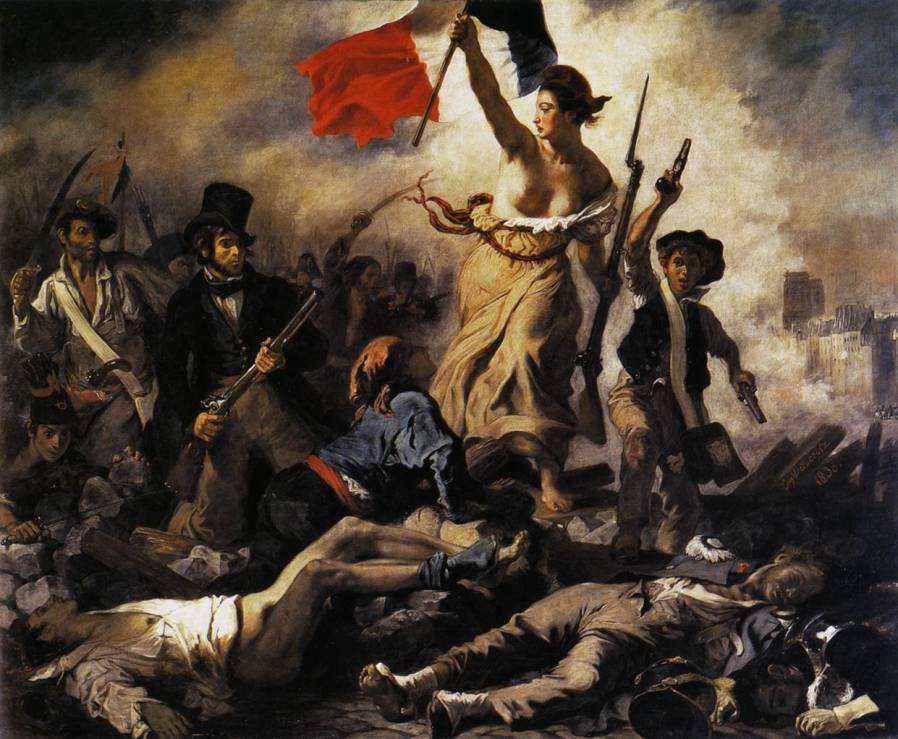
    In addition to the emotionally-charged feelings one got from looking at Romantic paintings, contemporary viewers were usually quite knowledgeable of the story behind the subject matter. Why? Because the artists frequently took their inspiration from current events. For example, when Théodore Géricault unveiled his gigantic masterpiece The Raft of the Medusa(1818-19), the French public was already well acquainted with the gory details following the 1816 shipwreck of the naval frigate Méduse. Similarly, Eugène Delacroix painted Liberty Leading the People (1830) fully aware that every adult in France was already familiar with the July Revolution of 1830.
    Of course, not every Romantic work related to current events. For those that did, however, the benefits were a receptive, informed viewership, and increased name recognition for their creators.

Delacroix Liberty leading the People, 1830
  • Lack of Unifying Style, Technique, or Subject Matter
    Romanticism wasn't like Rococo art, in which fashionable, attractive people engaged in fashionable, attractive pastimes while courtly love lurked around every corner -- and all of these goings-on were captured in a light-hearted, whimsical style. Instead, Romanticism included William Blake's disquieting apparition The Ghost of a Flea (1819-20), sitting in close chronological proximity to John Constable's comfortably rural landscape The Hay Wain(1821). Pick a mood, any mood, and there was some Romantic artist that conveyed it on canvas.
    Romanticism wasn't like Impressionism, where everyone concentrated on painting the effects of light using loose brushwork. Romantic art ranged from the smooth-as-glass, highly-detailed, monumental canvas Death of Sardanapalus (1827) by Eugène Delacroix, to J. M. W. Turner's indistinct watercolor washes in The Lake of Zug (1843), and everything in between. Technique was all over the map; execution was completely up to the artist.
    Romanticism wasn't like Dada, whose artists were making specific statements about WWI and/or the pretentious absurdities of the Art World. Romantic artists were apt to make statements about anything (or nothing), dependent on how an individual artist felt about any given topic on any given day. Francisco de Goya's work explored madness and oppression, while Caspar David Friedrich found endless inspiration in moonlight and fog. The will of the Romantic artist had the final say on subject matter.

Influences of Romanticism

The most direct influence of Romanticism was Neoclassicism, but there is a twist to this. Romanticism was a type of reaction to Neoclassicism, in that Romantic artists found the rational, mathematical, reasoned elements of "classical" art (i.e.: the art of Ancient Greece and Rome, by way of the Renaissance) too confining. Not that they didn't borrow heavily from it when it came to things like perspective, proportions, and symmetry. No, the Romantics kept those parts. It was just that they ventured beyond the prevailing Neoclassic sense of calm rationalism to inject a heaping helping of drama.


This Time Cover From 2009 Looks like a Liberty Leading the People Moment.


Tuesday, 27 August 2013

Grade 10 Colour Sourcebook


http://mongoose1.wordpress.com/category/duane-keiser/

"It's now time to put your sourcebook together:
[Collection of A3 posters]

  • Cover page
  • Experiments with collage cloud (+ notes)
  • Experiments with watercolours (+ notes)
  • Experiments with Hue; Intensity; Value (+ theory)
  • Experiments with EGGs (+ notes)
  • Investigations of other interesting art work (+ notes)
  • Experiments with acrylics and oils (+ notes)
  • Any drawings for your egg painting
  • Gallery visit - oil painting
  • Final egg painting" Link to the rest of Mrs Moore's Colour Sourcebook post

Saturday, 10 May 2014

Neoclassicism: Grade 11VA

As the 18th century drew to a close, France’s costly involvement in the American Revolution and extravagant spending by King Louis XVI (1754-1793) and his predecessor had left the country on the brink of bankruptcy. Not only were the royal coffers depleted, but two decades of poor cereal harvests, drought, cattle disease and skyrocketing bread prices had kindled unrest among peasants and the urban poor. Many expressed their desperation and resentment toward a regime that imposed heavy taxes yet failed to provide relief by rioting, looting and striking." Read More at http://www.history.com/topics/french-revolution 
Link to an article and video on the French Revolution

Some information from Mrs Moore's Blog:


The Oath of Horatii by Jacques-Louis David   1784 (1792 = French Revolution)


Create your first 'infographic' of the year by analyzing the above painting using these chunks:-


  • Basic data 
  • Context of the 'message'
  • Meaning / messages
  • Most obvious images that help convey the message
  • Most important elements and principles that help convey the message
  • Your opinion of the success of this painting. Would something like this work TODAY?
An infographic should have at least 2 illustrations and 300 words clearly divided into the above chunks. It may be on an A3 card, a double A4 or be digital (shared with studio@dghs.co.za)

Jessica's example Try evaluating this example using this tool ....